
Alaska threw out a rule most other states still follow. Maybe you inherited a cabin outside Palmer with your brother, or you bought a duplex in Spenard with a friend who’s since moved to Seattle. Either way, the ownership you think you have probably isn’t the one recorded on your deed. That one wrinkle decides how jointly owned property gets sold here, who has to sign, and what happens when somebody digs in. I’ve bought houses across Southcentral Alaska for years. In my experience, co-ownership fights are the most common reason a sale stalls before closing.
What Does Alaska Law Say About Jointly Owned Property Rights?
Your deed may well say “joint tenants with right of survivorship,” and you might figure none of this applies to you. Alaska abolished joint tenancy in real estate, though. Co-owners who aren’t married to each other hold as tenants in common even when the deed uses the words joint tenants. Alaska title companies see this all the time, usually on deeds someone drafted from an out-of-state form.
The conveyance statute controls. Under it, a deed to two or more people is read as creating a tenancy in common. Married couples are the exception, taking title as tenants by the entirety unless the deed expressly says otherwise. The text is posted at FindLaw’s listing for AS 34.15.110 if you want to read it yourself.
A share of jointly owned property in Alaska gives you an undivided fractional interest. You own a piece of the whole, not a particular room or corner of the lot.
Early last year I worked with the grown children of an elderly homeowner in Eagle River. Her mortgage was three months behind, and the trustee’s sale date had already been posted. Two siblings were on title with their mom, a third wasn’t, and nobody had looked at the deed since the 1990s. We figured out who actually had to sign, got everyone to the table, and closed before the auction date. The family’s snowmachine sat in the garage until they hauled it out the morning of closing.
Co-owners of property like this in Alaska also share the burdens, from taxes and insurance to upkeep.
How Does Joint Tenancy Differ From Tenancy in Common in Alaska?
Most families trip over this distinction because the two terms sound interchangeable. They aren’t. In Alaska, only one of them is really open to you for land.
Survivorship is the whole difference. A tenancy in common has none. When a co-owner dies, their fractional share passes by will or intestacy instead of sliding over to the surviving owners, and that usually means a court process. A parent in Alaska who adds a child to the deed thinking it avoids probate often gets the opposite result, with two shares to handle instead of one.
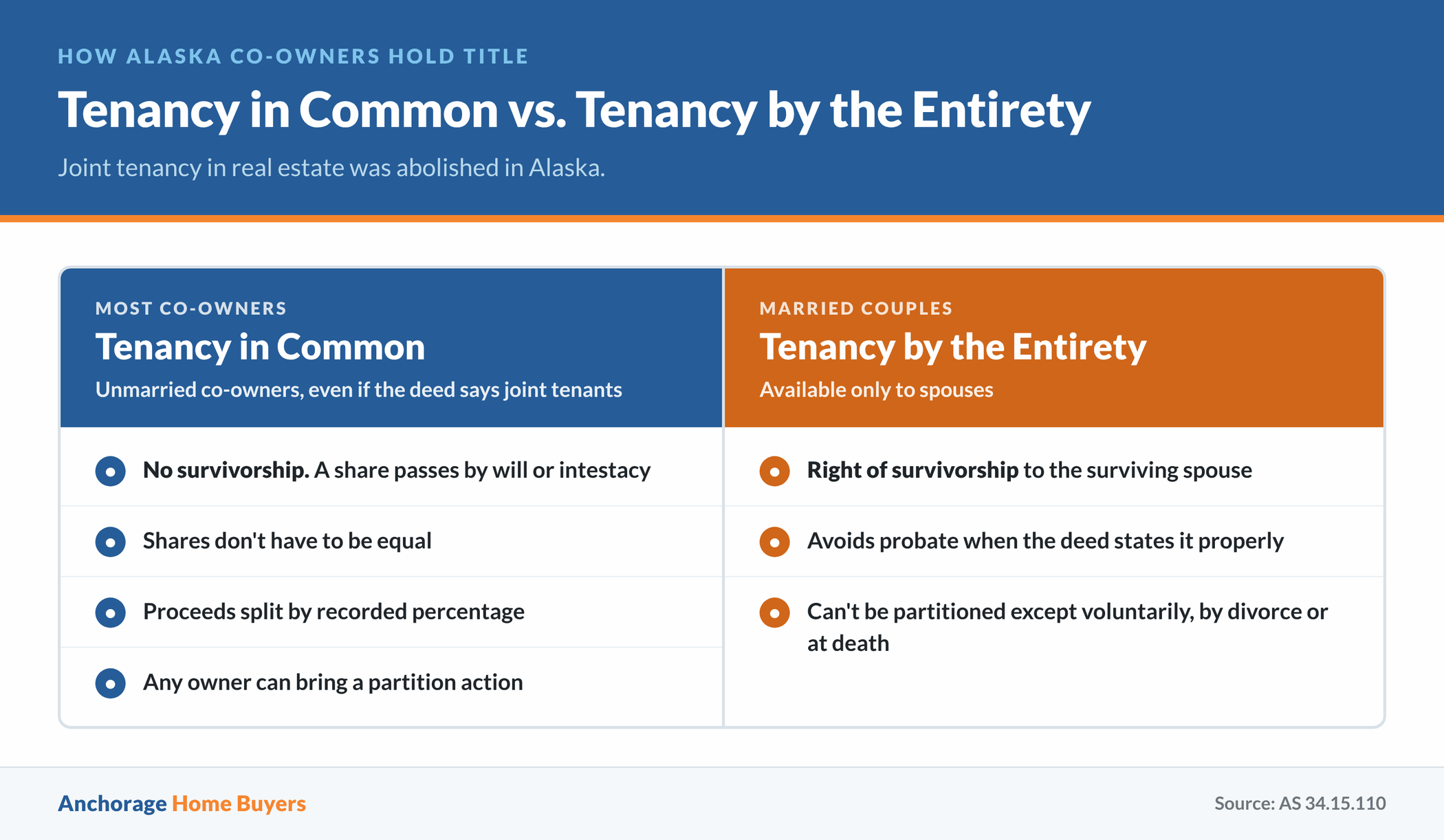
Married couples are in a different position. Only spouses can hold a tenancy by the entirety. It carries the right of survivorship, so the surviving spouse takes full ownership without probate when the deed states it properly. Alaska spouses can also hold survivorship community property by written agreement.
I’ve watched this play out on Alaska deeds again and again. My view is that a “joint tenancy” label printed on a document is worth almost nothing without a title search behind it.
Shares in a tenancy in common don’t have to be equal, either. One heir might own 50 percent while four others split the rest. That matters a lot when it’s time to divide proceeds, since the split follows the recorded percentages, not whoever put the most work into the place.
None of this means your deed is wrong. It means the words on it may not control the outcome. In Alaska, the statute beats the stationery.
Does Every Owner Have to Agree Before Selling Jointly Owned Property?
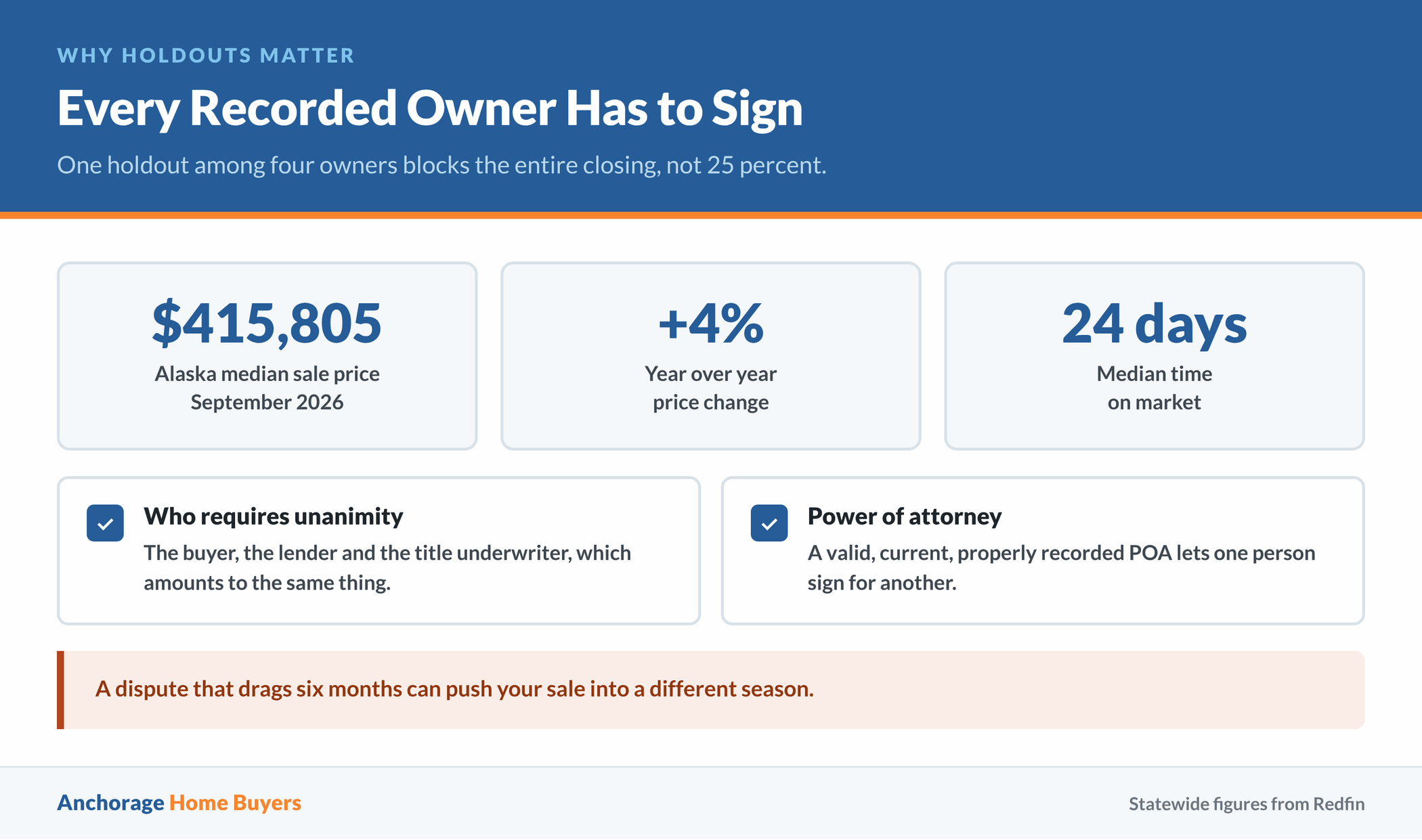
To deliver clean, marketable title to the whole parcel, every person holding a recorded interest has to sign the deed. One holdout among four owners won’t block 25 percent of the sale. That person blocks the entire closing. No Alaska title insurer will cover a buyer’s full fee interest when a co-owner never signed.
No statute requires everyone to agree. The buyer, the lender, and the underwriter do, and in the real world that amounts to the same thing.
Property jointly owned by a married couple as tenants by the entirety is locked down even tighter. That kind of tenancy can’t be dissolved or partitioned except voluntarily, through divorce, or at the death of one spouse.
Sellers often ask whether a power of attorney solves it. Sometimes it does. A valid, properly recorded POA lets one person sign for another. It has to be genuine and current, and the title company will look at it closely. A POA signed by a parent who has since lost capacity raises questions that take weeks to answer, and the durability language matters.
Disagreement has a hidden cost in Alaska, and it’s timing. In September 2026, homes statewide sold at a median price of $415,805, up 4 percent year over year, with a median of 24 days on market. A co-owner dispute that drags on for six months delays your money and also pushes you into a different season. Selling in January in Alaska is nothing like selling in June.
Can One Owner Sell a Jointly Owned Property in Alaska?
A co-owner looks at the house, cuts the value in half, and figures they can sell their half to anyone who wants it. The first half of that holds up. Finding just anyone to buy it falls apart once a buyer applies for a mortgage.
In Alaska, you can sell your undivided fractional interest in co-owned property. Nothing stops you from signing a quitclaim deed for your share and recording it at the state Recorder’s Office.
The market for a fractional share is mostly cash investors who specialize in partition litigation. They price accordingly, usually well under proportional value. Selling your piece to them is legal and fast, and it costs you.
Lenders matter here too. If a loan sits on the property, the note usually names every borrower, and transferring an interest can trigger a due-on-sale clause.
I keep seeing the same mistake. A co-owner deeds away their interest in anger and then learns they’re still on the mortgage. Credit reports in Alaska don’t care who holds title. They care who signed the note, and that signature follows you.
Buying out a co-owner is usually the better path, and it’s cleaner than it sounds. One owner refinances or pays cash and the other signs a deed. With one recording, jointly owned property becomes solely owned property. Our team at Anchorage Home Buyers hears from Alaska families who need that number in writing all the time.
What Happens to Jointly Owned Property When One Owner Wants Out?
Two sisters owned a Kenai duplex after their mother passed away. One lived in the lower unit and never wanted to leave. The other hadn’t been to Alaska in nine years and wanted her money.
That’s the usual pattern. Someone’s life changes, and the house stops fitting both people. You have four realistic ways out, and the wrong choice costs real money.

The first is a buyout, priced off an appraisal both sides agree to in advance. Second is a joint sale on the open market, with proceeds split by recorded share. A third choice is selling your fractional interest, covered above. Court is the last resort.
Before anyone files anything, I’d push for a written Alaska co-tenancy agreement. It settles more disputes than lawyers do. Spell out who pays for heating fuel and who plows the driveway. Cover what happens if one party stops chipping in and how a future sale gets triggered.
A co-owner who won’t return calls is frustrating. Document everything you pay. Keep receipts for taxes, insurance, and repairs on the jointly owned property, because Alaska courts can account for those payments when proceeds get divided.
Deferred maintenance hits Alaska co-owners harder than owners elsewhere. Frost heave, ice dams, and a crawlspace that stays wet through breakup add up fast, so a house nobody maintains loses value quicker here than in a mild climate. A stalemate has a carrying cost, and in Alaska that cost shows up in the foundation.
Can a Co-owner Force the Sale of Jointly Owned Property in Alaska?
Yes. The threat alone settles far more cases than the filing ever does.
Every tenant in common in Alaska holds the right to bring an action for partition. Even a 10 percent owner can file, and the court has to take it up.
Alaska courts look at physical division first. They order a sale when the property is so situated that partition can’t be made without great prejudice to the owners. A single-family home in Anchorage meets that standard easily. Forty acres off the Parks Highway may not, because you can actually divide the dirt.
For most jointly owned property in Alaska that’s a home, a partition suit ends in a court-supervised sale and a split of the proceeds.
Court-ordered sales rarely bring full retail. Attorney fees come out of the pot, the timeline can stretch across several Alaska seasons, and the referee process adds costs of its own.
That’s why I tell people the partition right works best as leverage.
What Is a Partition Action and How Does It Affect Jointly Owned Property?
File one, and a judge who has never seen your house decides what happens to it. That’s the honest tradeoff.
A partition action is a civil suit that asks the court to divide jointly owned property or order it sold. Alaska’s statute tells the court to order partition according to the parties’ respective rights. It also allows one or more referees to be appointed to carry out the division. The provision is posted at Justia’s page for AS 09.45.290.
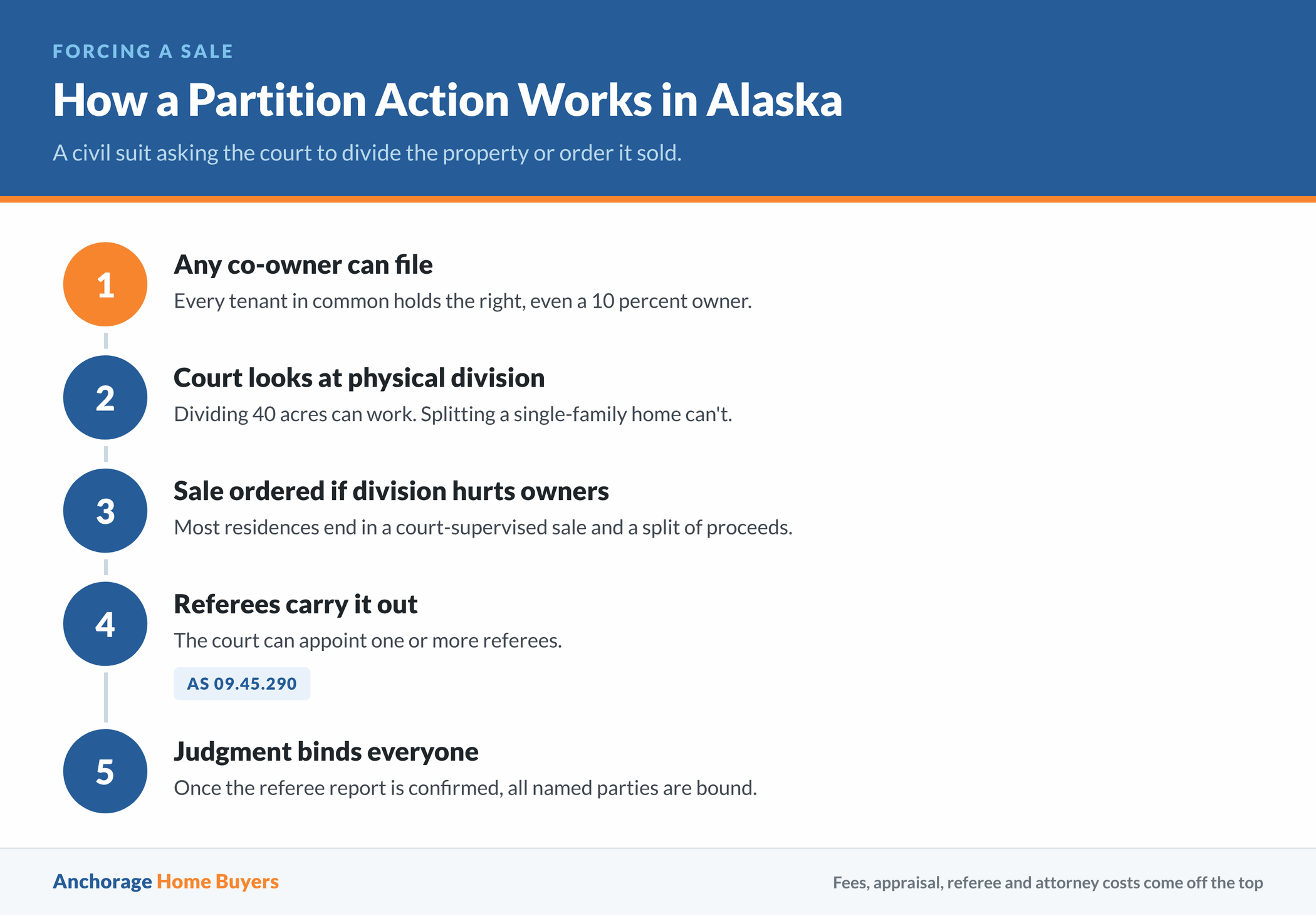
These judgments are more final than people expect. After the court confirms the referee report, the partition judgment binds every named party and their legal representatives. It also binds unknown interested persons who got notice by publication.
Filing fees come off the top, along with a survey if division is on the table, an appraisal, referee pay, and attorney time on both sides. On a modest Alaska house, litigation can eat a real chunk of equity. That chunk is often worth more than whatever the two sides were fighting over.
In September 2026, Alaska homes sold for about 99.2 percent of list price. A cooperative sale usually lands close to asking.
A woman settling her father’s estate in Wasilla saw two agent listings expire without a single offer. The house needed a new roof, and buyers kept walking after inspection. By the time we talked one Thursday afternoon, she’d paid two winters of heating bills on an empty house. Selling as-is to a direct buyer like Anchorage Home Buyers wrapped it up in under three weeks, and her brother signed remotely from Juneau.
Common Questions About Selling Jointly Owned Property in Alaska
For a long time I assumed a recorded deed told you everything about who owns an Alaska house. I was wrong.
Alaska’s statewide recording system is run by the State Recorder’s Office, with 34 separate recording districts served by just two offices.
When a co-owner has died, probate adds another layer. A tenancy in common share doesn’t transfer on its own, so the estate has to move it. Until it does, the living co-owners can’t deliver full title to jointly owned property in Alaska, however much they agree.
Selling jointly owned property in Alaska also raises tax questions. Capital gains treatment depends on each owner’s basis and on whether that owner lived in the house. Heirs typically get a stepped-up basis as of the date of death. The answers depend on your facts, so a CPA licensed in Alaska is the right person to run them.
Frequently Asked Questions
How Do You Look Up Land Ownership Records in Alaska?
Begin with the Alaska Department of Natural Resources Recorder’s Office, which keeps the statewide index of deeds, mortgages, easements, and liens. Its free online search works by name, date, document number, document type, or subdivision, and you’ll find it on the DNR Recorder’s Office site. For state-managed land, surveys, and plats, the DNR Land Records portal also pulls in federal BLM records. If the chain of title looks tangled, hire a title company. They do this every day and catch things a casual search misses.
Can My Co-owner Rent Out the House Without Asking Me?
Generally, yes. A tenant in common can possess and use the whole property, renting included, because each co-owner has an equal right to the entire parcel. They can’t keep all the money or lock you out, though. If one owner collects rent on jointly owned property in Alaska and pockets it, the others usually have a claim to their proportional share. A court can sort that out in an accounting when the property is eventually divided or sold.
What If One Co-owner Refuses to Pay the Mortgage or Taxes?
Hang on to every receipt and bank record showing what you paid. A co-owner who covers the shortfall normally has a right to contribution from the others, and those amounts get settled when proceeds are divided. Waiting costs you, though. Unpaid property taxes in Alaska can eventually lead to a borough foreclosure process, and a lender won’t care which of you stopped paying once it starts default proceedings.
Does a Transfer-on-death Deed Help with Co-owned Alaska Real Estate?
It can. Plenty of Alaska families use one to get the survivorship result they thought a joint tenancy deed gave them. A transfer-on-death deed names who receives your interest when you die and takes effect only at death, so you keep full control while you’re alive. It won’t fix a present-day dispute between living co-owners. Have an Alaska attorney draft it so the language holds up at the Recorder’s Office.
Can I Sell My Share of a House in Alaska to a Family Member?
Yes. A family transfer is often the smoothest way out of jointly owned property in Alaska. A quitclaim or warranty deed moves your fractional interest, and recording it is simple. Check with your lender first to see whether the transfer triggers anything under your note. Also, the buyer doesn’t take on your mortgage obligation unless the loan is formally assumed.
How Long Does It Take to Sell a Co-owned House in Alaska?
If everyone cooperates, a traditional Alaska listing takes about a month of marketing plus 30 to 45 days to close financing. Figure two to three months from decision to funds, longer in winter or for a remote location. A direct cash sale skips the appraisal and loan underwriting. That can get co-owners to the closing table in two or three weeks, as long as every person on title signs.
Sharing a house with someone whose plans no longer match yours is hard, and you don’t have to sort out the next step alone. We’re happy to look at your deed, show you what a sale would actually net each owner, and tell you straight if listing makes more sense than selling direct. Reach out to Anchorage Home Buyers whenever you’re ready. There’s no obligation, and no hard feelings if you decide to wait.
Co-Owned Houses in Anchorage
Inventory in Anchorage stays tight, with Redfin showing about 2.0 months of supply in the metro for the first half of 2026. A fairly priced co-owned house usually draws interest, as long as every owner is ready to sign. If the owners can’t agree on repairs or timing, a direct cash sale gives everyone a firm number to discuss.
Ask About a Cash Offer for a Co-Owned House
A shared house is easier to sort out once you have real numbers. Contact us to talk through your situation, or fill out the form below to ask for a no-obligation cash offer.
Helpful Alaska Blog Articles
- How To Sell Your Alaska Home With Mold Issues
- Can You Sell A House With A Mortgage In Alaska
- How to Sell a House by Owner in Alaska
- Sell A Fire-Damaged House in Alaska
- Can You Sell A House in Foreclosure in Alaska
- Sell a House with Foundation Issues in Alaska
- Sell a House with a Lien in Alaska
- How to Find a Realtor in Another State
- Sell a House with a Pending Insurance Claim
- How Long Can You Go Without Paying Property Taxes
- Can I Sell My Parents House with Power of Attorney
- Can a Jointly Owned Property Be Sold by One Owner in Alaska
- Selling a House With Termite Damage in Alaska