
A Spenard homeowner phoned me one January, sure that termites were eating her floor joists. She had the frass, the trim that sounded hollow when she tapped it, and a few winged bugs on the windowsill. Selling a house with suspected termite damage in Alaska begins with a question hardly anyone asks first: does the insect you’re worried about even live in this state?
How Big Is Alaska’s Termite Problem, Really?
I spent years repeating what Outside contractors told me, figuring our cold just slowed termites down. I was wrong. Alaska is the one state with no established termite species, and carpenter ants are the wood-destroying insect you should watch for instead. Pest pros in the rainforest towns back that up. They say wood-destroying insects are common in southeast Alaska, even though the state is the only one in the country without termites.
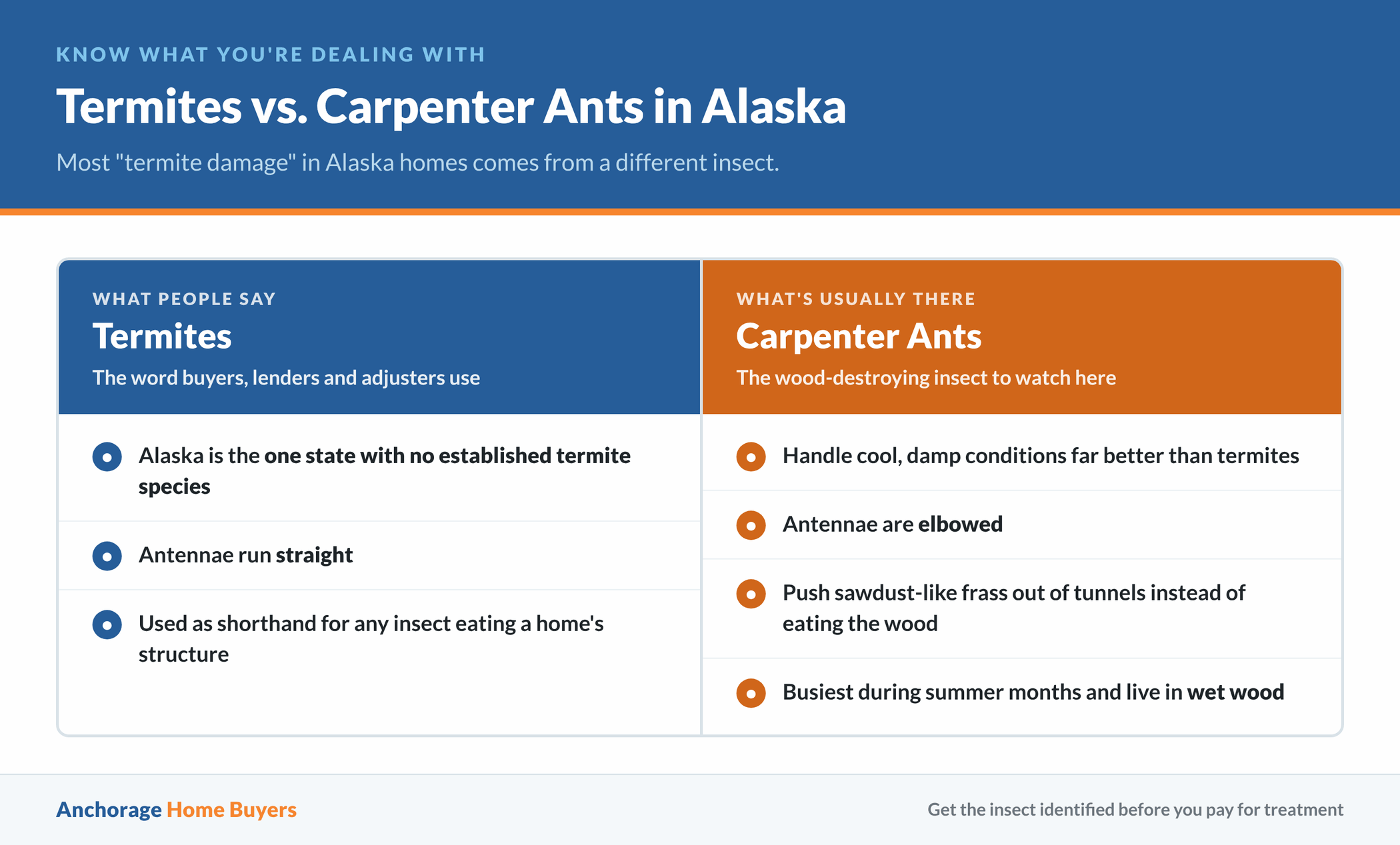
The word sticks around anyway. Buyers, lenders, out-of-state families, and insurance adjusters all say “termite damage” when they mean any insect chewing on a home’s structure. A home inspector writes up gnawed sill plates in a Fairbanks basement, and that’s the phrase the seller hears. The real culprit is nearly always something else. The repair bill looks the same either way.
In Alaska, the chewing most often comes from a carpenter ant colony. These ants tolerate our cool, damp weather far better than termites would, and they’re busiest in summer. They also don’t eat the wood. They tunnel through wood and push sawdust-like frass out of their galleries.
A few years ago I bought a house in Palmer from a widow who’d been quietly paying two mortgages for close to eleven months. Her husband had started ripping out a chewed rim joist one Saturday and never got to finish it. That half-gutted crawlspace sat open for two winters while she kept paying on a place she’d already left. Her kids didn’t know.
If somebody prices a termite job for you in Alaska, slow down. Have UAF Cooperative Extension identify the insect before you spend a dime, because odds are it’s carpenter ants. I’ve seen sellers pay for treatments they didn’t need while the actual moisture source kept rotting the framing.
What Alaska Law Requires You to Disclose About Termite Damage
Your disclosure duty shows up earlier in the sale than most sellers expect. Alaska’s rule is AS 34.70. It requires a seller of residential real property to hand over a completed written disclosure statement, on a form the Alaska Real Estate Commission sets. That has to happen before the buyer writes an offer, not after, and certainly not at closing.
The Alaska residential real property transfer disclosure statement, form 08-4229, runs 13 pages and was last revised in May 2024. That’s a lot of boxes to fill out honestly. This plain-language guide to the disclosure form from an Alaska real estate school explains how the statute and the form work together.
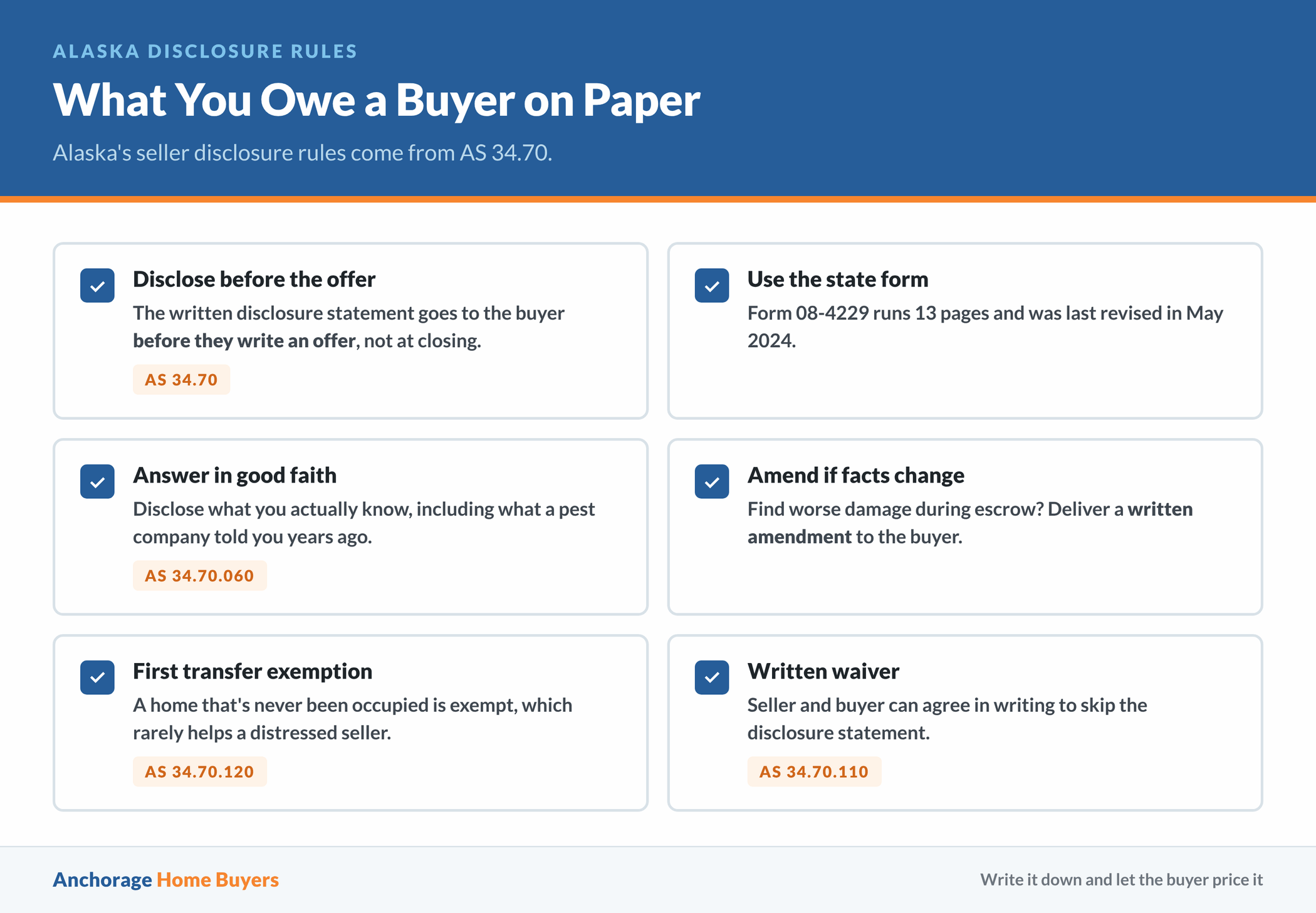
Under AS 34.70.060, every disclosure has to be made in good faith. You answer from what you actually know about the property. If a pest company told you in 2019 that you had an infestation, you disclose that you were told so.
Two exceptions are worth knowing if you’re selling in Alaska. A home’s first transfer, when nobody has ever lived in it, is exempt under AS 34.70.120, which rarely helps a distressed seller. Under AS 34.70.110, the seller and buyer can also agree in writing to waive the disclosure statement entirely.
Your disclosure can go stale, too. If something happens after you delivered it that changes the answers, Alaska requires a written amendment to the buyer. Open a wall during escrow and find worse termite damage than you described? You’d owe an amendment, and the form sits right in the state’s disclosure packet.
My take, stated plainly: hiding termite damage in Alaska is about the worst move a seller can make, because the repair you’re covering up costs less than the lawsuit you’re inviting. Write it down and let the buyer price it.
Can You Sell a House with Termite Damage as Is in Alaska?
“Nobody’s going to touch a house with chewed-up framing.” I hear it a lot, and it’s wrong in this market. Alaska inventory is thin enough that damaged properties still trade. Statewide, active listings sat at 2,196 in October 2026, a small pool for a state this big.
Selling as-is means you won’t repair the termite damage or give a credit for it. It doesn’t mean you get to hide it.
Financing is where as-is sales in Alaska get tricky. The VA doesn’t generally require wood-destroying insect paperwork in Alaska, though an appraiser who spots signs of infestation can still order an inspection. The VA state-by-state requirements breakdown puts our state among the discretionary states. There, inspections happen only when the VA appraiser calls for one, most often after seeing current or past wood-destroying insect damage.
In plain terms, visible termite damage in an Alaska crawlspace can trigger the very inspection that would otherwise never happen. That’s worth knowing as a seller.
Conventional lenders work much the same way. The appraiser notes structural insect damage and flags the file. Then the underwriter wants a repair estimate, and your buyer’s 45-day close drags into something uglier.
Whether to fix it anyway comes down to scope. Surface damage on a few feet of trim is a weekend project. Compromised sill plates under a two-story in Eagle River mean jacking up the structure, which is another thing entirely. My advice to sellers is to get the estimate before deciding, not after promising a buyer a repair.
Who Pays for Termite Damage When Buying a Home in Alaska?
“Is this coming out of my proceeds?”
With a traditional Alaska listing, the buyer orders the inspection, the report names the termite damage, and the negotiation begins. Sellers with decent leverage push repairs back. According to Redfin’s state tracker, Alaska homes sold at a median of $415,805 in September 2026, up 4.0% year over year, and sellers got 99.2% of list price. Sellers aren’t giving away the farm in that market, yet they don’t win every repair fight either.
I see the same three endings again and again. Sometimes the seller repairs before closing. Other times the seller gives the buyer a credit at closing and the buyer handles the work. The cleanest option is a lower price so everyone can move on, and that’s the one I’d push for when the termite damage in an Alaska home is mostly cosmetic.
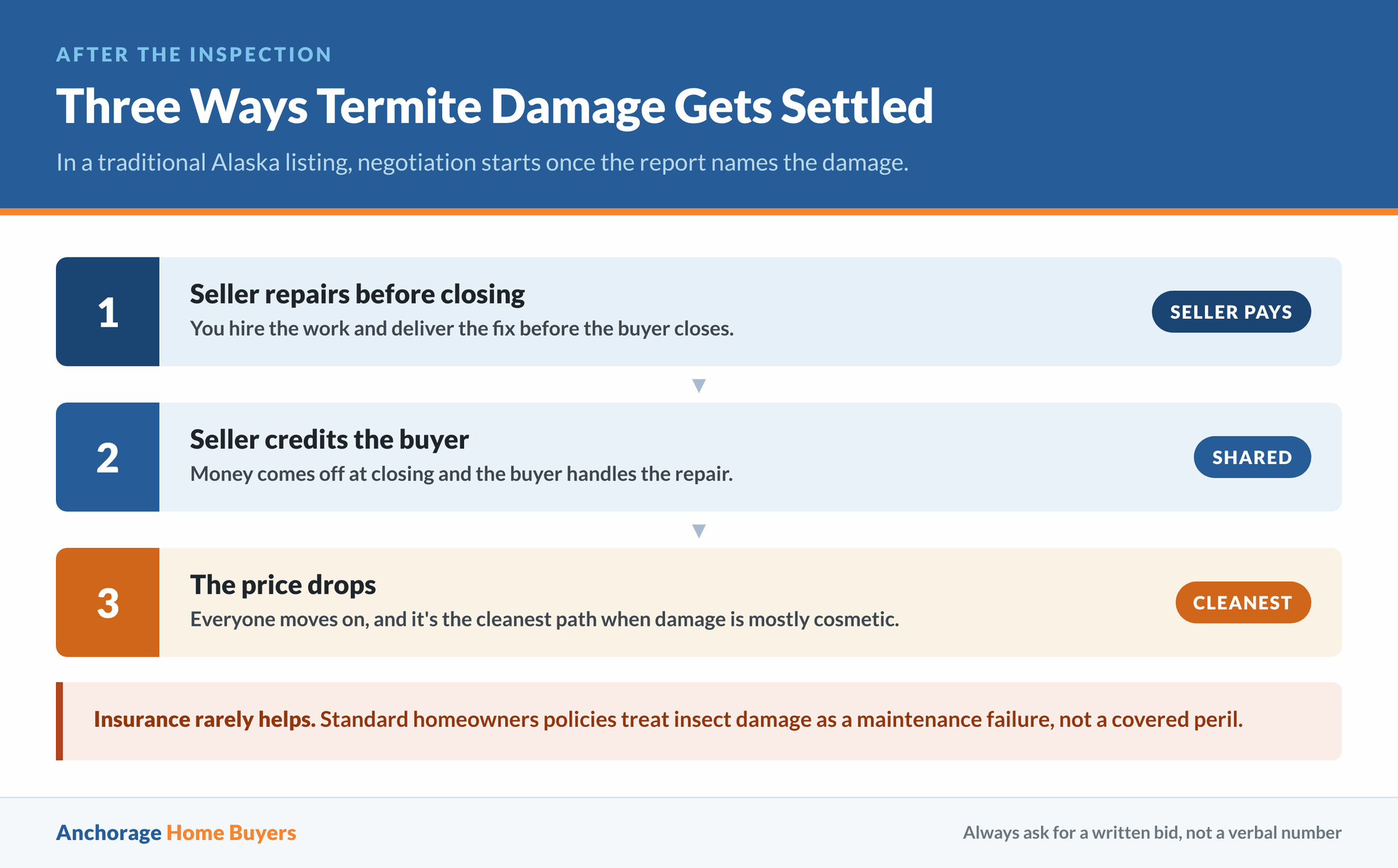
Don’t count on insurance. Standard homeowners policies treat insect damage as a maintenance failure rather than a covered peril, and your insurance company will tell you so in writing. Compare that with fire damage, where a claim pays for the rebuild. Sellers who expect an insurance claim to cover termite damage in Alaska lose weeks learning otherwise.
I keep seeing the same mistake. A buyer gets a scary number from a contractor over the phone, asks for that amount off the price, and the seller agrees with nothing in writing. Between a nervous guess and an itemized estimate, the gap can be huge, so always ask for paper.
A direct cash sale keeps the math simple. The buyer takes on the termite damage, prices the offer around it, and you walk away without picking up a tool.
What Steps to Take Before Selling a House with Termite Damage in Alaska
Skip the pest company for now. Call an entomologist first, then someone who knows structural work, and only then decide about selling. I’ve watched that order save Alaska sellers real money dozens of times.
Have the extension service identify the insect, not a sales rep whose paycheck rides on a treatment contract. The National Pesticide Information Center notes that carpenter ants have elbowed antennae, while termite antennae are straight. Bag a sample and bring it in.
After that, find the water. Carpenter ants nest in wet wood, which is why swapping out water-damaged wood is part of the fix. Usually the real culprit behind so-called termite damage in Alaska homes is a leaking valve, a plugged gutter, or an ice dam on the roofline.
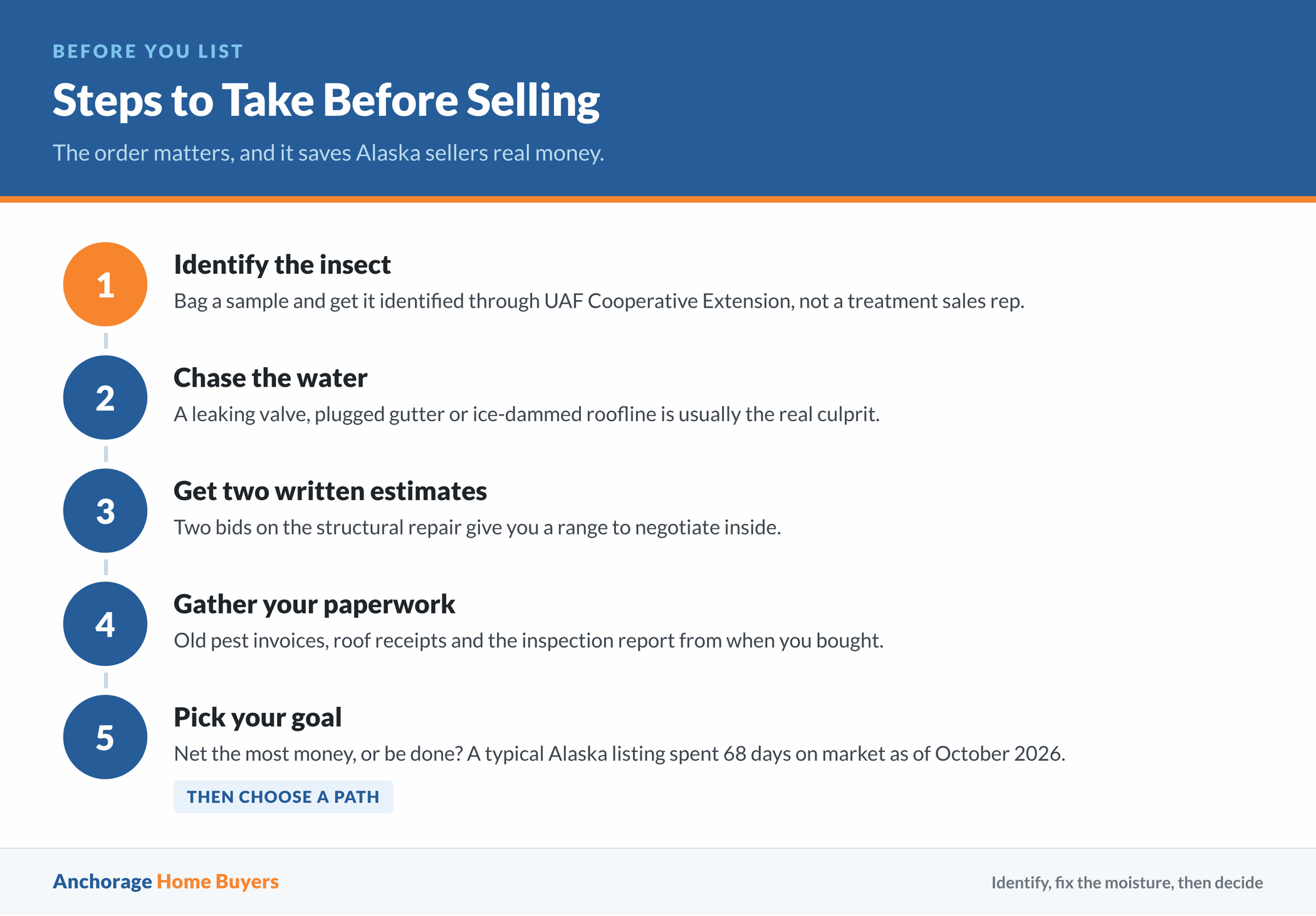
Then get two written estimates on the structural repair. One isn’t enough, and three is overkill. With two, you have a range to negotiate within.
Gather your paperwork too. Old pest treatment invoices, the receipt for the roof work, and the inspection report from when you bought all help. Buyers relax when they see organized records on termite damage in an Alaska property. Buyers who get a shrug assume the worst and lowball you.
Now for pricing. Decide whether you want the most money or a finished sale, because those call for different plans. Sellers who won’t choose tend to end up listing, sitting, then reducing. As of October 2026, a typical Alaska listing spent 68 days on market before it sold or was pulled, per this statewide market report. Add escrow and you’re close to 100 days. If you can’t absorb that, a direct sale is worth a look. Anchorage Home Buyers will give you a number to compare against a listing before you commit either way.
Which Alaska Cities and Towns See the Most Termite Damage?
If you price a Ketchikan house the same as a Fairbanks house, you’ll either leave money on the table or sit unsold through breakup. Wood-destroying insect pressure in Alaska isn’t spread evenly. Neither are the markets that absorb it.
Southeast Alaska’s wet climate softens wood. Homes there with wood siding, exposed beams, and thin insulation make prime nesting sites, more so when upkeep slips because of remote access or short work seasons. Sellers in Juneau, Sitka, Petersburg, Wrangell, and Ketchikan all report what they call termite damage, since Alaska’s rainforest belt keeps structural wood damp most of the year.
Anchorage bowl neighborhoods have their own pattern. Think of Hillside homes with mature spruce crowding the eaves, older Mountain View and Fairview stock sitting low to grade, and Turnagain crawlspaces that never dry out. Trim tree limbs back from wood structures, since ants cross from branch to siding.
Mat-Su construction from the 1980s building boom comes up a lot as well. Wasilla, Big Lake, and Houston have plenty of wood-on-grade decks and additions that went up fast. Additions like those are a big reason we buy houses in Wasilla in as-is condition.
Interior properties around Fairbanks and North Pole face permafrost settling that cracks framing and lets moisture in, and moisture brings insects. People blame termites for the damage there all the time. In a state with no termites, they’re always wrong about the species and often right about how bad it is.
A Fairbanks landlord I worked with got a contractor estimate to gut his kitchen after years of chewed cabinet boxes and a soft floor under the sink. The estimate came in higher than the whole kitchen added to the property’s value. I’ve typed that line in my notes more than once. He’d kept the old cabinet doors in his garage for three years, sure he’d reuse them. We bought the place with the doors still stacked there.
Southwest hub towns and coastal villages face their own version. Lumber arrives by barge, humidity runs high, and contractors are scarce enough that a small repair can stretch over two seasons.
Why Choose Our Termite Damage Home Buying Service in Alaska
Alaska’s fastest sales go to clean, photogenic, move-in-ready houses. A property with open framing and visible insect damage won’t keep that pace.
We buy Alaska houses with termite damage, carpenter ant damage, dry rot, fire damage, and the deferred maintenance that makes retail buyers flinch. No agent commission, no repair escrow, and no lender ordering an inspection three days before closing. You choose the closing date, and we work around it.
I won’t tell you a cash offer beats a listing on price, because it mostly doesn’t. Some sellers are working through probate or a job transfer to the Lower 48. A few are tired of flying out to check on a rental. Others can’t carry a second mortgage one more month. Sellers like that tend to value a sure closing date over the last few percent.
Our team knows how Alaska houses are built. We’ve crawled under enough of them in Anchorage, the Mat-Su, and the Interior to price insect and moisture damage without padding for unknowns. You’ll see that in the offer.
A Quick Note on Comparing Offers
Get a written offer from a direct buyer and a listing presentation from a Realtor, then subtract honestly. Take out commission, concessions, carrying costs, repairs, and the months of mortgage payments in between. Put both columns on paper. With the real estate math in front of you, the right answer tends to jump out. Plenty of sellers who call Anchorage Home Buyers end up listing instead, and we’re fine with that.
Frequently Asked Questions
Does a Past Termite Treatment Help When I Sell in Alaska?
It helps, as long as you can show what the treatment covered and whether anyone did the structural repairs. Treatment kills the insects; it doesn’t replace chewed wood. Gather the pest company’s records, any warranty paperwork, and a structural opinion on the load-bearing members before a buyer asks. In this state, also confirm which insect the treatment targeted, because misidentification happens a lot up here.
Do I Have to Tell Buyers About Termite Damage in Alaska If It Was Repaired?
Yes, if you know about it. The state’s disclosure form asks about known defects and past repairs, and a repaired problem is still something you know. A description of the termite damage, the repair, and who did the work protects you far better than silence. Buyers forgive history you disclosed. They don’t forgive surprises that turn up after closing.
Will a Home Inspector in Alaska Find Termite Damage I Don’t Know About?
A good one will find insect damage, moisture intrusion, and rot in the crawlspace and attic, where most of it hides. Naming it correctly is another matter. Many Alaska inspectors write it up as wood-destroying insect activity and refer you to a pest specialist, and that’s the right call.
Can I Sell a House with Termite Damage in Alaska Without Fixing Anything First?
Yes, you can. Lots of Alaska sellers do just that, going either to a cash buyer or to a retail buyer who’d rather have a price concession than a repair. It works when you price the termite damage into the sale honestly and put the condition in writing. Sales fall apart when sellers try to land halfway between as-is and move-in-ready.
Does Homeowners Insurance Cover Termite Damage?
Almost never. Insurance companies call insect damage a maintenance issue. Your policy covers sudden events like fire and burst pipes, not slow structural loss. Read your own policy before assuming anything. If an adjuster already denied a claim, keep that letter in your file.
How Much Does Termite Damage in Alaska Reduce a Home’s Value?
Mostly it comes down to whether load-bearing wood is involved. Cosmetic damage to trim and cabinets barely moves the number. Compromised sill plates, joists, or posts can take a real chunk off, since the buyer is pricing in jacking, shoring, and a contractor’s calendar. Two written estimates will tell you more than any percentage rule of thumb.
Who Should I Call First If I Think I Have Termite Damage?
Call UAF Cooperative Extension first to identify the insect. Next, bring in a structural contractor or a qualified inspector to look at the wood. A pest control company can come third. Sellers who flip that order end up paying for a treatment plan that never fixes the moisture problem behind the damage.
Selling a Damaged House in Anchorage
Anchorage houses still sell fast when the price matches the condition. Redfin put the metro’s median time on market at about 23 days for the first half of 2026. A house with chewed framing or open walls probably won’t hit that number, and that’s okay. We buy houses across the Anchorage bowl, the Mat-Su, and the Interior, and you can compare a cash offer with a listing before you decide.
Get a Cash Offer on Your Termite-Damaged House
If you’d rather not sink money into the house, we’re happy to walk through the property with you. We’ll go over what the repairs would really cost and give you a straight number to weigh against listing. There’s no obligation, and no hard feelings if a Realtor turns out to be the better fit.
Can’t decide whether to repair, list, or sell as-is? Contact us and tell us about the house. Or fill out the short form below, and we’ll follow up with a no-obligation cash offer.
Helpful Alaska Blog Articles
- How To Sell Your Alaska Home With Mold Issues
- Can You Sell A House With A Mortgage In Alaska
- How to Sell a House by Owner in Alaska
- Sell A Fire-Damaged House in Alaska
- Can You Sell A House in Foreclosure in Alaska
- Sell a House with Foundation Issues in Alaska
- Sell a House with a Lien in Alaska
- How to Find a Realtor in Another State
- Sell a House with a Pending Insurance Claim
- How Long Can You Go Without Paying Property Taxes
- Can I Sell My Parents House with Power of Attorney
- Can a Jointly Owned Property Be Sold by One Owner in Alaska
- Selling a House With Termite Damage in Alaska