


I once watched a title officer kill a closing three days out over a signature page with no notary stamp. Everything else was in order. The buyer’s loan was funded, the movers were booked, and the family had already given away the furniture.
When you sell a parent’s home on their behalf, family stress runs straight into real estate law, and the paperwork doesn’t forgive mistakes. A power of attorney can get the job done. It has to say the right things, though, and you have to act within the authority it gives you. Some documents hold up and some get rejected, and the difference usually comes down to a few lines of text.
What Does Power of Attorney Let You Do with a House?
That authority is narrower than most families picture when they first pull the folder from the filing cabinet. A power of attorney names you as the attorney-in-fact, so you can act in your parent’s place on specific matters. For a home sale, that can mean signing the listing agreement, accepting an offer, and signing the deed at closing. A real estate authorization can also let the agent reach bank accounts tied to the property and hire professionals to prepare it for sale.
You’re the fiduciary here, and courts take that word seriously.
Each choice you make has to serve your parent. It can’t serve you, your siblings, or the family’s convenience. The Uniform Power of Attorney Act makes the agent a fiduciary of the principal, someone who must take actions that benefit the principal.
Gifts are where family money gets messy. An agent has no authority to make gifts from the principal’s income or assets unless the power to make gifts is written into the document in plain terms. Selling the house to yourself at a family discount is a gift dressed up as a sale, and title companies know how to spot it.
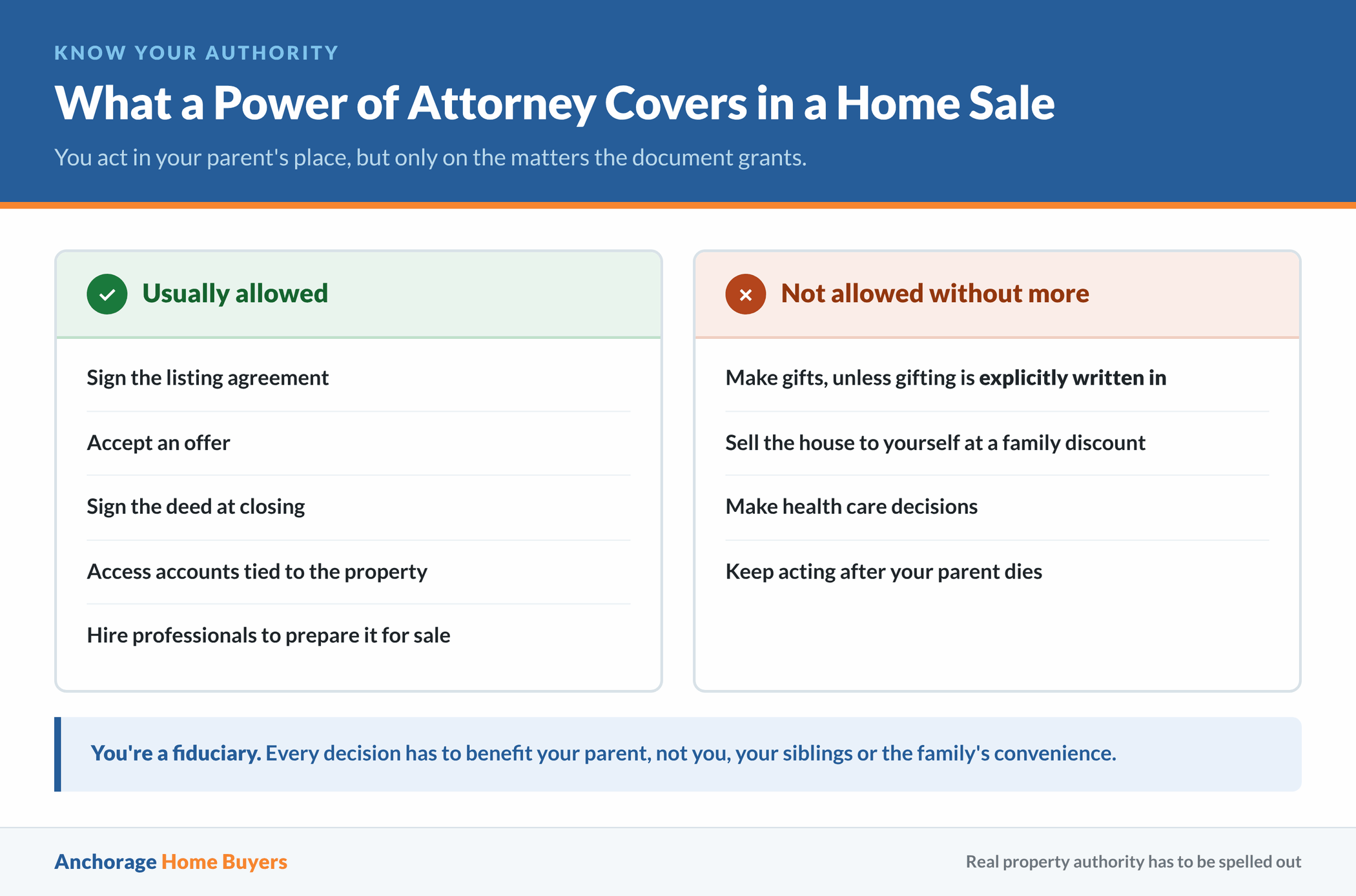
Pay attention to what the document doesn’t do, too. It gives you no say over medical care unless a separate health care directive exists. Standard statutory language says so directly: a financial authorization does not authorize the agent to make health care decisions.
One couple I worked with had taken in the husband’s mother after a fall. Nobody in that household wanted to be the person who said the old house should go.
Can I Sell My Parents’ House with Power of Attorney?
You can, as long as the paper in front of you actually says so.
An agent acting under one can sell property, though only when the document explicitly grants authority over real estate transactions and meets the legal requirements. Vague financial wording won’t make it through underwriting. Title companies reject a general POA that never mentions real property, and they usually catch it right at closing.
Read the powers section out loud and listen for verbs like sell, convey, transfer, and mortgage. California, for example, requires real estate POAs to use specific verbs such as “convey,” “sell,” “mortgage,” or “encumber.” Exactly how explicit the wording must be varies by state. An hour with a real estate attorney in your parent’s state is money well spent.
Underneath that sits a second question. Did your parent have capacity when they signed? Florida, as one example, requires the document to be signed while the principal was mentally competent, witnessed by two people, notarized, and recorded in the county where the property sits. I’ve seen closings stall over exactly this. One signed after a dementia diagnosis invites a challenge from anyone with an interest in the estate.
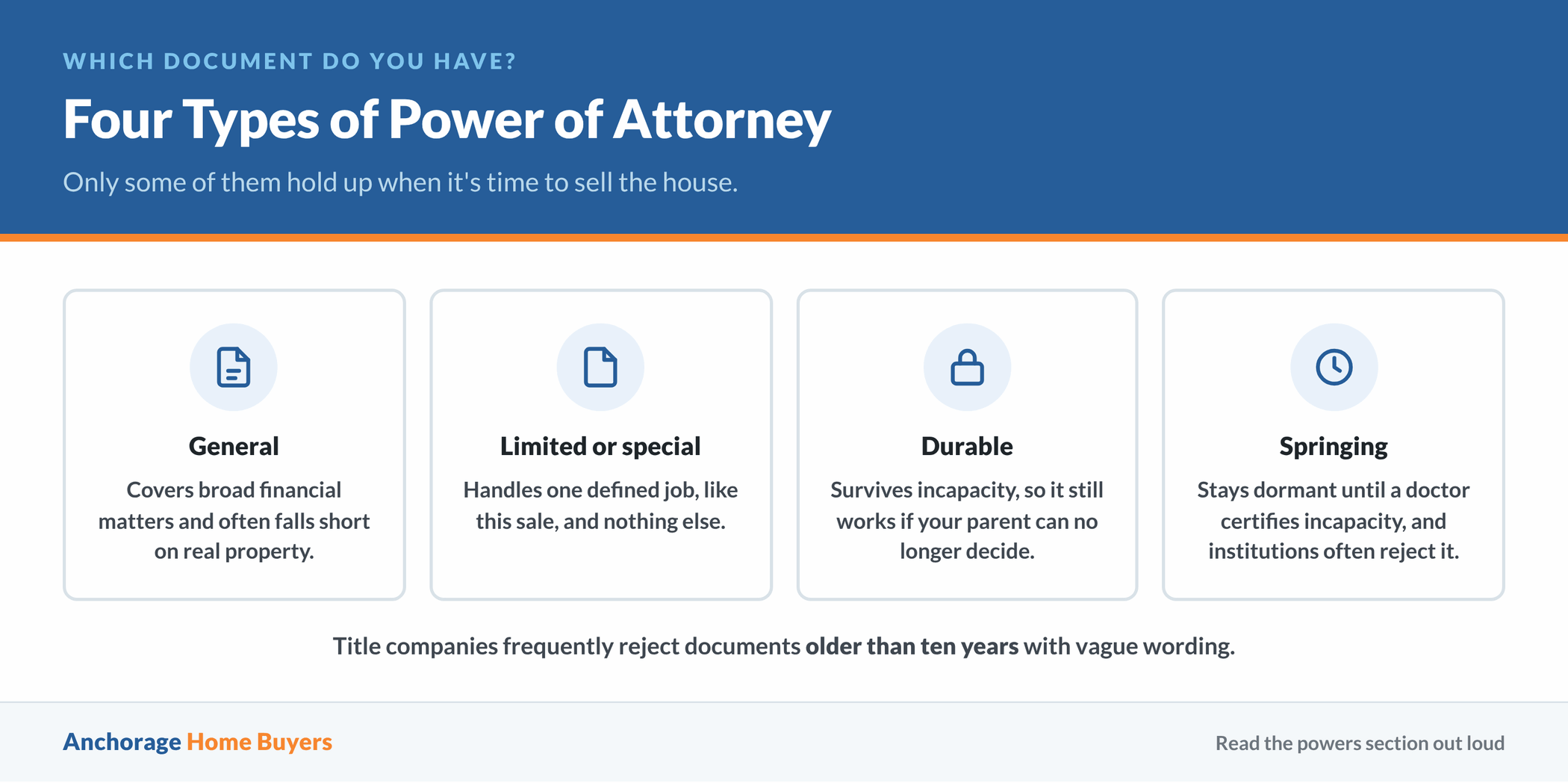
Age matters more in this corner of real estate law than people expect. Title companies frequently reject documents older than ten years, especially vague ones, since outdated forms may not meet current notarization or recording standards.
What Type of Power of Attorney Do You Need to Sell Property?
According to Redfin, the typical home that sold in the four weeks ending September 13, 2026 spent 46 days on the market, and the national median sale price hit $393,895 in September. Add escrow and you’re looking at two to three months. A rejected POA in week six wipes out that whole timeline.
Most of these files come in one of three types. A general authorization covers broad financial matters and often falls short on real property. A limited or special version handles one defined job, like this sale, and nothing more. The durable version is the third, and it gets its own section below.
Some attorneys suggest drafting a limited document just for the transaction, even if a broader one is already sitting in a drawer at home. A probate-focused agent cited in one industry guide sums up the California approach bluntly: the limited authorization document for the transaction gets drafted, notarized, and recorded. Siblings also tend to trust a narrow document more.
A springing version stays dormant until something triggers it, usually a physician’s certification of incapacity. In practice, it creates a mess.
First the agent has to prove incapacity. That means getting a physician’s certification in a form the third party will accept, from a doctor willing to write one, with HIPAA limits on what can be released. Banks often reject the form and demand their own.
If your family is still planning, I’d skip the springing structure altogether.
Durable vs Non-durable Power of Attorney: Which One Covers Home Sales?
“My mom signed something years ago, so we’re fine.” Maybe. That depends on one word buried in the document and on whether your mother can still make her own decisions.
A power of attorney terminates when the principal dies or when the principal revokes it. If the document isn’t durable, it also ends once the principal becomes incapacitated, which means a non-durable arrangement disappears at exactly the moment most families need it.
Durable means it survives incapacity. With a durable power of attorney, your agent keeps legal authority to handle real estate transactions even after cognitive decline leaves the principal unable to make decisions.
A detail complicates things here. The Uniform Power of Attorney Act flips the old default, so a document created under it lasts through incapacity unless the document itself says otherwise (§104). Not every state has adopted that act, and some that did made amendments. Your parent’s state law controls, so confirm the rule instead of assuming durability. In Alaska, a power of attorney isn’t durable unless the document says it is.
Families often assume a later guardianship wipes out the existing arrangement. Under the Act, it doesn’t. The agent’s authority continues even after a court appoints a fiduciary, unless the court orders otherwise.
Pull out the document and look for the durability clause. If five minutes of reading doesn’t turn it up, it’s probably not there. Talk to a lawyer before you call a real estate agent.
How Do You Get Power of Attorney to Sell Your Parents’ House?
Most families picture a trip to the courthouse, a filing fee, and a judge’s signature. It works the other way around. You don’t get a power of attorney. Your parent grants one, voluntarily, while they still have the capacity to understand what they’re signing. No court is involved.
That difference decides which road you’re on. A competent parent can sign one next week. If your parent has already lost capacity, they can’t, and your family is headed toward a guardianship or conservatorship petition. That means courts, filings, and a lot more money.
With a competent parent, the steps are simple enough. An estate or real estate attorney drafts a document that spells out real property authority. Your parent signs it in front of a notary. Most states require the principal’s signature to be notarized, and several states add witnesses on top of that.
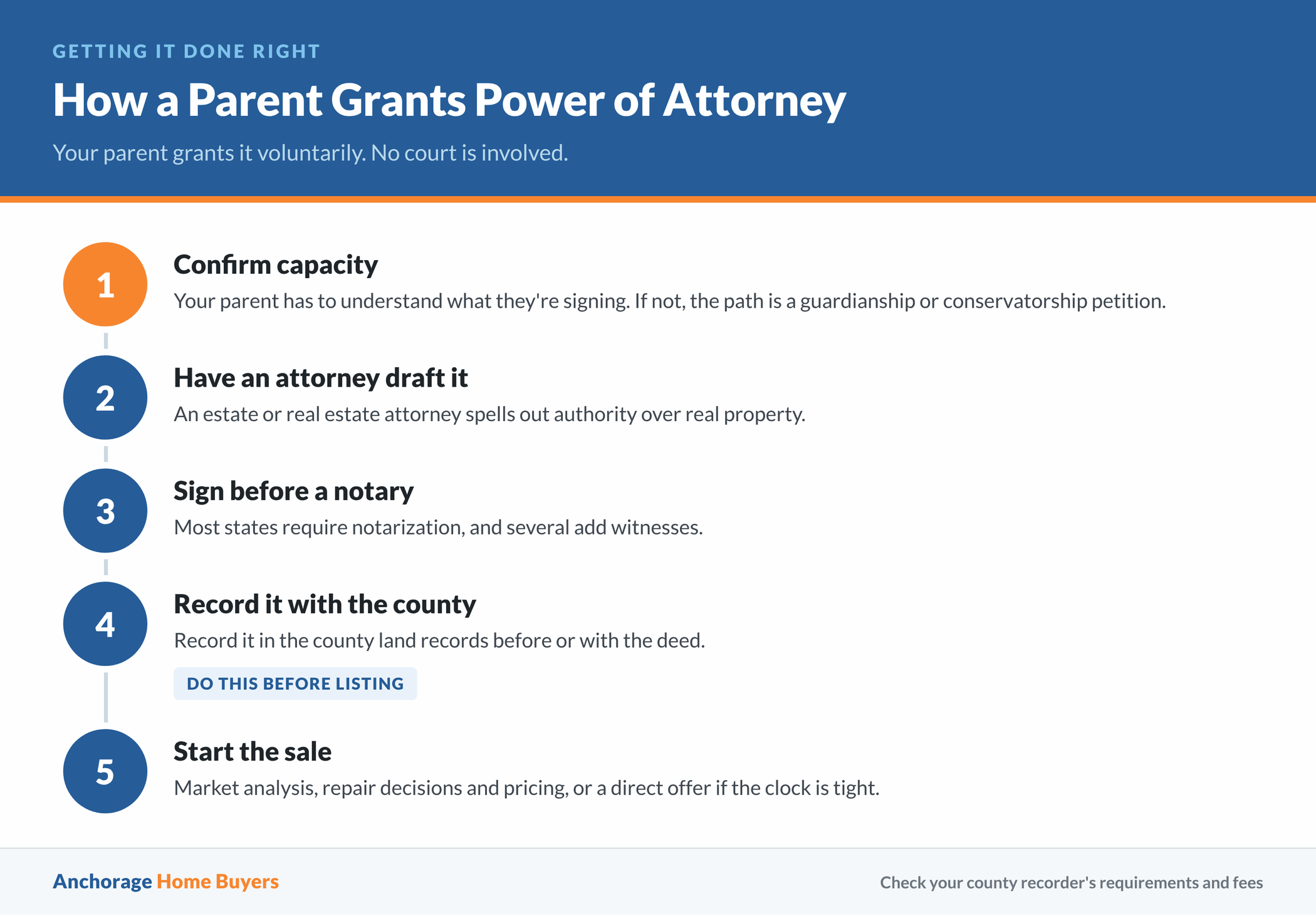
In many places, the power of attorney itself gets recorded in the land records of the county where the property sits, alongside the deed. That puts the public on notice that the agent had authority to act. The recording has to happen before the deed is recorded or at the same time. Your county clerk or recorder can tell you their exact requirements and fees. Alaska has no counties, so an Alaska house gets recorded through the State Recorder’s Office in the recording district where it sits.
Handle it early. Recording turnaround times vary, and it’s far better to finish this step before the property is listed than to scramble during escrow.
With the document in hand, the normal work of selling starts: a comparative market analysis, decisions about repairs, and pricing. Some sellers take a direct offer, especially when the house needs work or time is short. If you’re weighing a simple sale against months of showings, Anchorage Home Buyers is one option worth a conversation.
How to Prepare Your Parents’ House for Sale Under Power of Attorney
For years I told families to empty the house completely before showing it. That advice cost some of them money they didn’t need to spend.
Buyers can’t look past a roof that’s clearly failing or a basement that smells like standing water. Put your money into the things an inspector will write up and skip the rest.
Good records protect you better than staging. Save each offer, counteroffer, and email from the broker, along with the comparative market analysis behind your asking price. If a sibling questions the sale two years from now, that paper trail is your defense.
If anyone connected to the family is involved in the sale, get an independent appraisal. Self-dealing, where the agent transfers assets to themselves, requires express authorization, and it’s the most abused provision in these documents.
Look hard at the market before you commit to a listing plan. The National Association of Realtors reported a median existing-home price of $416,700 in October 2026. Homes spent a median of 35 days on the market, up from 34 days a year earlier. Where your parent’s house sits changes how long you can afford to wait.
When you sign, show your parent’s name first, then yours, then your role as attorney-in-fact. Signing only your own name on a deed creates a title defect that tends to surface at the worst possible moment.
Keep utilities, insurance, and property taxes current through closing. Vacant-home insurance is a separate product from a standard homeowner’s policy. If coverage lapses while the house sits empty, you carry that risk personally as the fiduciary.
What Are the Legal Risks of Selling a Parent’s Home Under Power of Attorney?
Your authority ends the instant your parent dies. A power of attorney terminates at the principal’s death. If that happens mid-escrow, your signature can’t close it. The sale moves into probate, and the executor named in the will takes over.
The biggest exposure is a breach of fiduciary duty. If you sell too cheap, sell to a relative, or pay yourself from the proceeds without authorization, heirs or a court-appointed fiduciary can sue you. A court can find that an agent violated the fiduciary duties under a power of attorney or is unfit to perform them.
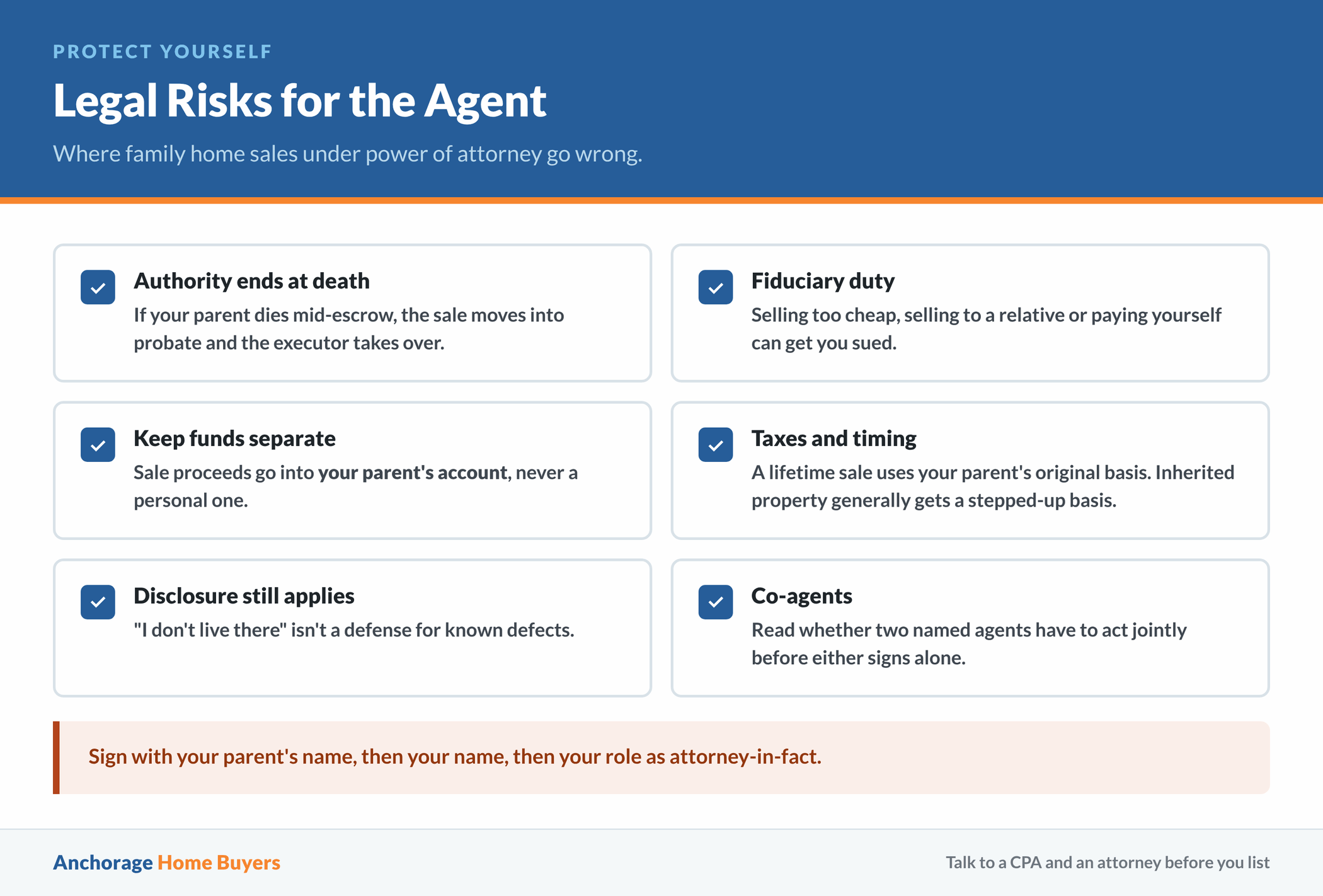
Where do the sale proceeds go? Straight into your parent’s account. Mixing funds is the fastest way to turn a legitimate sale into an accusation of elder financial abuse.
Taxes are a separate conversation. If you sell during your parent’s lifetime, capital gains are figured against their original basis. Inherited property generally gets a stepped-up basis instead. On a house held for forty years, the gap between those numbers can be huge. Have a CPA run both scenarios before you list, since the timing of a sale can matter more than the price you negotiate.
Being an agent instead of the owner doesn’t soften your disclosure duties. Most states require sellers to disclose known material defects. “I don’t live there” won’t work as a defense if your parent told you about the foundation crack.
Watch for co-agents, too. Some documents name two siblings and require them to act jointly. Co-agents aren’t required to act together unless the document says so, so read the special instructions carefully before either of you signs anything alone.
What Happens If a Parent Revokes Power of Attorney Before Closing?
A revocation you don’t know about can leave you signing documents you had no authority to sign. The fallout lands on you, not the buyer.
Revocation by the principal ends the power of attorney outright. The principal gives written notice of revocation to the agent and to any third party relying on the document, and the revocation takes effect when that notice is received.
The statute does protect people acting in good faith. A termination isn’t effective against an agent or anyone else who acts in good faith under the power of attorney without actual knowledge of it. That act still binds the principal and the principal’s successors. It won’t shield you if your parent told you on the phone last week and you signed anyway.
In practice, a revocation mid-escrow stops the sale. A competent parent can sign the closing documents personally or appoint someone else. If capacity is truly in doubt, the family faces a court proceeding, and the buyer will probably walk.
Most parents who revoke do it because nobody kept them in the loop. I’ve seen more transactions die from a parent feeling steamrolled than from any legal defect. Call weekly, send them the offer, and let them say yes out loud.
A direct buyer like Anchorage Home Buyers can make sense when you just don’t have the emotional bandwidth.
Frequently Asked Questions
Can You Sell a Home If You Have Power of Attorney?
Yes, if the document specifically grants authority over real property and your parent was competent when they signed it. Title companies usually reject broad financial language on its own, so have a real estate attorney review the wording before you list. Most states also want the document notarized and recorded with the county where the house sits.
What Should I Treat as a Red Flag with a Power of Attorney?
Be wary of an agent who won’t share account statements or sale documents with other family members. A document signed around the time of a dementia diagnosis is a warning sign. So is a proposed sale to the agent or a relative of the agent at a price comparable sales can’t justify. Vague gifting language deserves a second look, since transferring assets to yourself requires explicit authorization in the document. If something feels off in your family’s situation, an elder law attorney can review it quickly, and the fee is small compared to what litigation costs.
Does the Document Have to Be Recorded Before Closing?
In many states, yes. The recording happens in the county where the property is located. Requirements differ, so check with your county recorder or clerk about what they need and how long their turnaround runs. Get it done before you accept an offer, not during escrow, because a recording backlog can push back a closing date you’ve already committed to.
What If My Parent Has Already Lost Capacity and Never Signed Anything?
Then a power of attorney is off the table, because granting one requires the capacity to understand what’s being signed. Your family’s path runs through a guardianship or conservatorship petition in probate court, and that takes time and legal fees. An elder law attorney in your parent’s state can explain how that process works locally and whether a faster alternative exists.
Can I Use the Proceeds to Pay My Parent’s Bills?
Yes, as long as the sale proceeds land in your parent’s account first and the bills you’re paying are truly theirs. Nursing home costs, medical bills, property taxes, and outstanding debts all count. Keep every receipt. Never route money through a personal account, even for a day, because a clean paper trail protects you if anyone questions the transaction later.
If you’re sorting through a parent’s house and trying to work out the right move, we’re happy to talk it through, whether or not you ever sell to us. The answer might be a listing agent, or it might be waiting six months. Call when you’re ready and bring your questions.
Selling a Parent’s House in Anchorage
When your parent’s house is in Anchorage, the local market gives you some room to plan. Redfin put the metro’s median sale price at $432,513 for the first half of 2026, up 4.4 percent from a year earlier. That number helps when you’re weighing a listing against a faster cash sale.
We buy houses for cash throughout Anchorage and the surrounding area.
Families in nearby Eagle River can reach out, too. We buy houses in Wasilla and across the rest of Alaska as well.
Talk With Us About Your Parent’s House
Got questions about selling under a power of attorney? Contact Anchorage Home Buyers and tell us where things stand. Or fill out the form below to ask for a no-obligation cash offer.
Helpful Alaska Blog Articles
- How To Sell Your Alaska Home With Mold Issues
- Can You Sell A House With A Mortgage In Alaska
- How to Sell a House by Owner in Alaska
- Sell A Fire-Damaged House in Alaska
- Can You Sell A House in Foreclosure in Alaska
- Sell a House with Foundation Issues in Alaska
- Sell a House with a Lien in Alaska
- How to Find a Realtor in Another State
- Sell a House with a Pending Insurance Claim
- How Long Can You Go Without Paying Property Taxes
- Can I Sell My Parents House with Power of Attorney
- Can a Jointly Owned Property Be Sold by One Owner in Alaska
- Selling a House With Termite Damage in Alaska